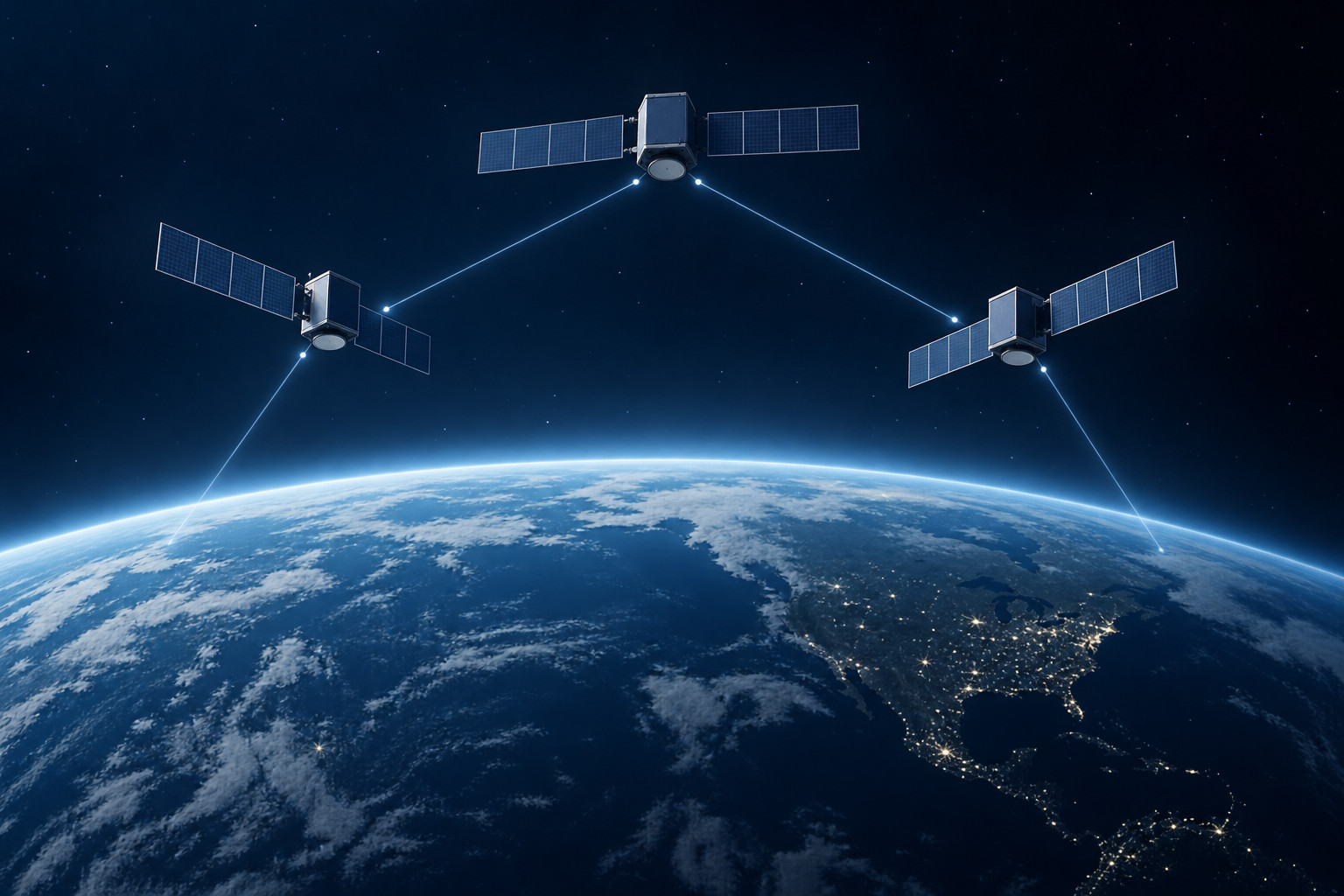
The Federal Communications Commission announced on November 25, 2026, that it had authorized SpaceX’s Starmind orbital data-center constellation, with a ceiling of up to one million satellites. The decision advances the proposed AI infrastructure project beyond an application, but does not establish that the network has been deployed or demonstrated commercial computing capacity. (FCC)
The FCC describes the planned modules as processing large amounts of data for use on Earth and calls the decision the first U.S. authorization for a constellation of data centers in space. That description concerns the system’s intended function, rather than a measurement of its operating performance. (FCC)
What the authorization covers
The communications permission covers backup and emergency telemetry, tracking and command—the links used to monitor and control spacecraft. The FCC announcement identifies frequencies of 18.8–19.3 GHz for transmissions toward Earth and 28.6–29.1 GHz for transmissions toward the satellites, supplementing optical links between spacecraft. It is not an announcement of customer-facing computing service. (FCC)
The distinction matters for AI infrastructure buyers. Permission to operate communications links answers a regulatory question; it does not quantify how much useful computing a satellite can deliver. Nor should the constellation’s maximum satellite count be read as an equivalent number of terrestrial data-center buildings. The agency describes orbital computing modules, not a standardized unit of AI performance. (FCC)
Deployment milestones are not a service timetable
According to Light Reading’s account of the FCC decision, the authorization sets a progression of deployment milestones: an initial milestone in November 2033, 10% of the authorized maximum by November 2035, 50% by November 2038 and completion by November 2040. At the ceiling stated by the FCC, the reported intermediate milestones correspond to 100,000 and 500,000 satellites. (Light Reading)
These are deployment requirements as reported by Light Reading, not evidence of completed launches or a company launch schedule. The distinction is important when assessing the project’s progress: the reported milestone dates describe obligations attached to permission, rather than a forecast of when customers could obtain computing services. (Light Reading)
Astronomers challenge the decision
The American Astronomical Society objected to the authorization on November 25, after petitioning the FCC to deny the application in March. The society warned that the proposed constellation could undermine astronomical research and public observation of the night sky, while raising concerns about the broader orbital environment. These are the organization’s anticipated impacts, not observations of a deployed Starmind network. (American Astronomical Society)
The society’s opposition highlights a separate test for orbital AI infrastructure: whether a system can coexist with scientific uses of space and the sky. Regulatory permission and a technically functioning computer would not, by themselves, resolve those concerns. The AAS statement frames the issue as protecting astronomical research alongside commercial innovation, rather than judging AI processing performance. (American Astronomical Society)
A sector moving from proposals to experiments
Recent developments elsewhere show why authorization, hardware demonstration and commercial scale should be treated as different milestones. Google reported on October 1 that a Project Suncatcher prototype, developed with Planet, had launched aboard a SpaceX rideshare mission. The company said it had established contact and that the satellite was operating as expected. (Google)
On October 30, Google reported that the prototype had produced an AI response using a data-center-class Tensor Processing Unit, its specialized AI processor. It described early machine-learning tests and said further experiments would evaluate performance under thermal stress and radiation exposure. That is a reported hardware demonstration—not proof that an orbital computing service can compete economically with facilities on Earth. (Google)
Google has also begun arranging a larger deployment step. On November 19, it announced a partnership with Blue Origin for a dedicated heavy-lift Suncatcher launch targeted for the first quarter of 2029. Google described the planned satellites as having roughly the computing capacity of a data-center rack. The launch remains a future target, separate from the prototype already in orbit. (Google)
Engineering and economic questions remain
The engineering questions extend beyond getting processors into space. In its September account of Suncatcher, Google identified radiation, launch vibration and cooling in a vacuum as challenges. It also described the precision needed for high-bandwidth laser connections between moving satellites, with a two-satellite test planned for 2027. Those are challenges Google identifies for its own research, not findings about Starmind’s hardware. (Google)
For builders and investors, these developments suggest distinct measures of progress: authorization, reliable hardware operation, interconnected computing and viable service economics. SpaceX’s FCC decision addresses the first of those. Google’s experimental results illustrate another. Neither a regulatory ceiling nor a successful early AI response, on its own, establishes sustained capacity, competitive cost or readiness to replace terrestrial infrastructure. (FCC)