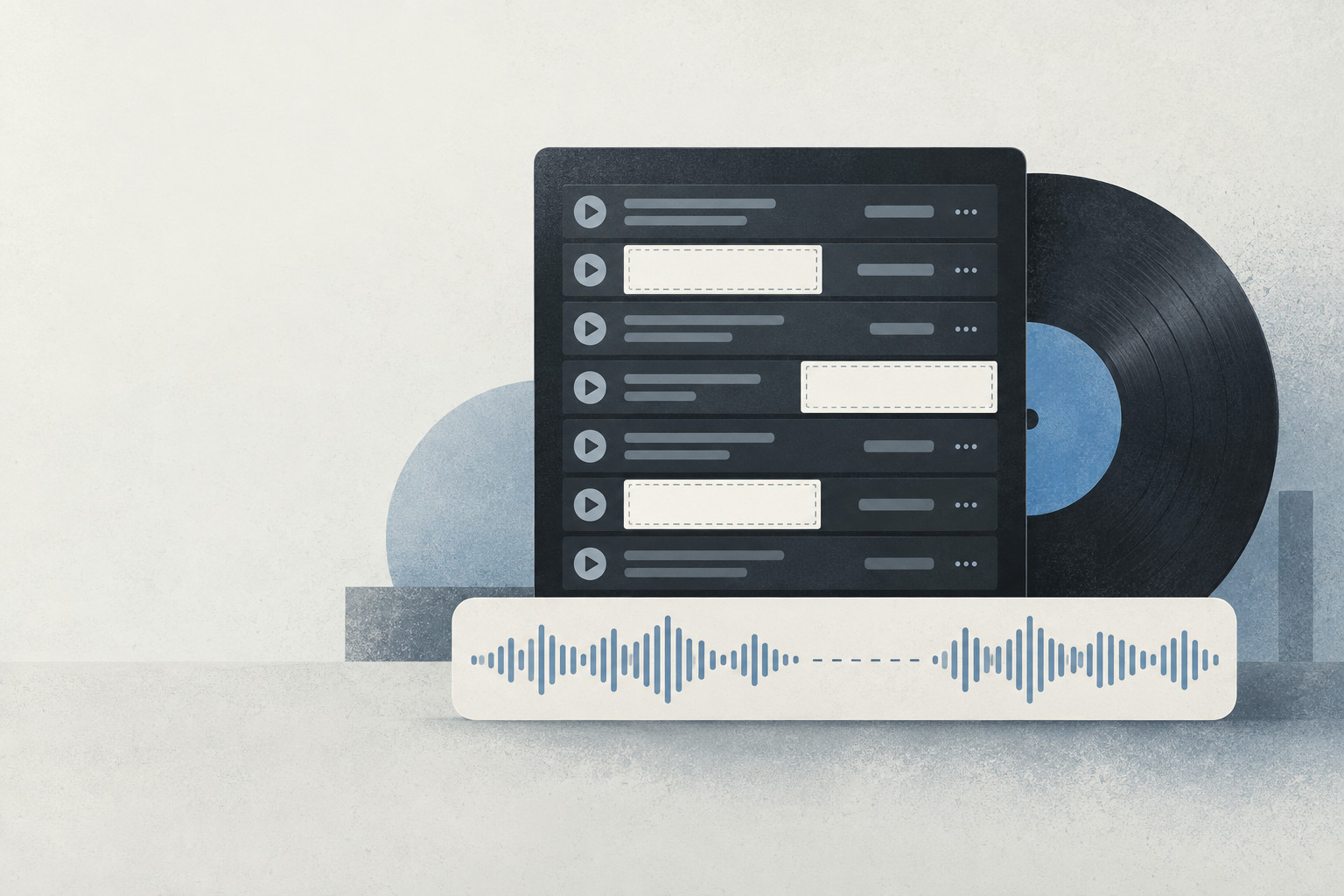
YouTube announced on October 14, 2026, that it is rolling out labels for music created with substantial generative-AI involvement, including AI-created composition and vocals. The listener-facing wording is “Made with AI,” according to The Verge, and the company says the labels will also extend to the main YouTube app. (YouTube)
On YouTube Music, the label will appear directly on the player page. Tapping it opens a menu with additional information. The announcement does not provide a rollout completion date or a country-by-country schedule, so it should not be read as confirmation that every listener already has the feature. (YouTube)
The change combines information from music partners with YouTube’s own identification efforts. That makes it a transparency measure, rather than evidence that the platform can reliably identify every AI-generated recording. The announcement provides no detection-accuracy figures or independent evaluation of the tools it says it uses. (YouTube)
Which uses fall within disclosure
YouTube’s music-partner guidance asks partners to disclose generative-AI involvement and offers three declarations: “Fully Gen AI,” “Partly Gen AI,” and “No Gen AI.” These distinguish entirely generated content from work containing generated components and work made without generative AI. They are partner declarations, not three separate listener-facing badges announced for the player. (YouTube Help)
The categories accommodate mixed production. A track combining generated musical components with an artist’s live performances can fall into the partly generated category. By contrast, the guidance places standard pitch correction used to fix minor tuning mistakes in a live vocal performance in the no-generative-AI category. (YouTube Help)
That distinction matters for creators: the relevant question is not simply whether software was involved in production. Generating musical material and correcting the pitch of a recorded performance receive different treatment in the examples. The pitch-correction exception should not be stretched into an assumption that every editing or production tool is exempt. (YouTube Help)
The public label and partner declaration also serve different purposes. One communicates AI involvement to listeners; the other supplies information that can inform platform treatment. Reading a short badge as a complete account of a song’s creative process would give it more meaning than these materials establish. (YouTube)
What happens without disclosure
The Verge reports that YouTube may use “other signals” to determine whether a song is AI-generated when partners have not disclosed that use. YouTube’s current guidance confirms that partner declarations are not its only source of information. Omitting a declaration therefore does not guarantee that a track will avoid an AI designation. (The Verge)
The company separately says it is working with music partners and using its own detection tools. Neither statement establishes how accurate those tools are, or whether the unspecified signals and detection tools refer to precisely the same mechanism. An unlabeled song should consequently not be treated as certified human-only work. (YouTube)
TechCrunch reports that AI involvement alone does not make a track ineligible for monetization. (TechCrunch) That separates the disclosure question from the question of whether a recording can earn revenue; the presence of a label is not, by itself, a verdict on the music’s quality or creative merit.
Other platforms distinguish different kinds of AI use
The broader industry context shows why the meaning of a label needs attention. Spotify announced an AI Persona badge on August 11, 2026, addressing whether an artist’s public identity represents a real person. Its announcement explicitly distinguishes that identity question from how the artist’s music was made. (Spotify)
Spotify also provides AI credits for particular contributions, such as lyrics, vocals or production. Its current guidance describes those credits as optional, in beta and visible on mobile in song credits and the Now Playing view. Unlike an overall track label, they attach AI information to individual creative roles. (Spotify Support)
The comparison illustrates separate transparency questions: whether a performer’s public identity is synthetic, whether a recording contains generated material, and which contributions involved AI. Treating all three as interchangeable would obscure distinctions the services themselves make. A listener may need more than a badge to understand what was disclosed. (Spotify)
For creators and distributors, the practical implication is that disclosure information needs to describe the work accurately, rather than merely attach a broad AI designation. For listeners, YouTube’s label offers a more visible starting point for understanding a track—not a complete authorship record or a guarantee that every unlabeled recording was made without generative AI. (YouTube Help)