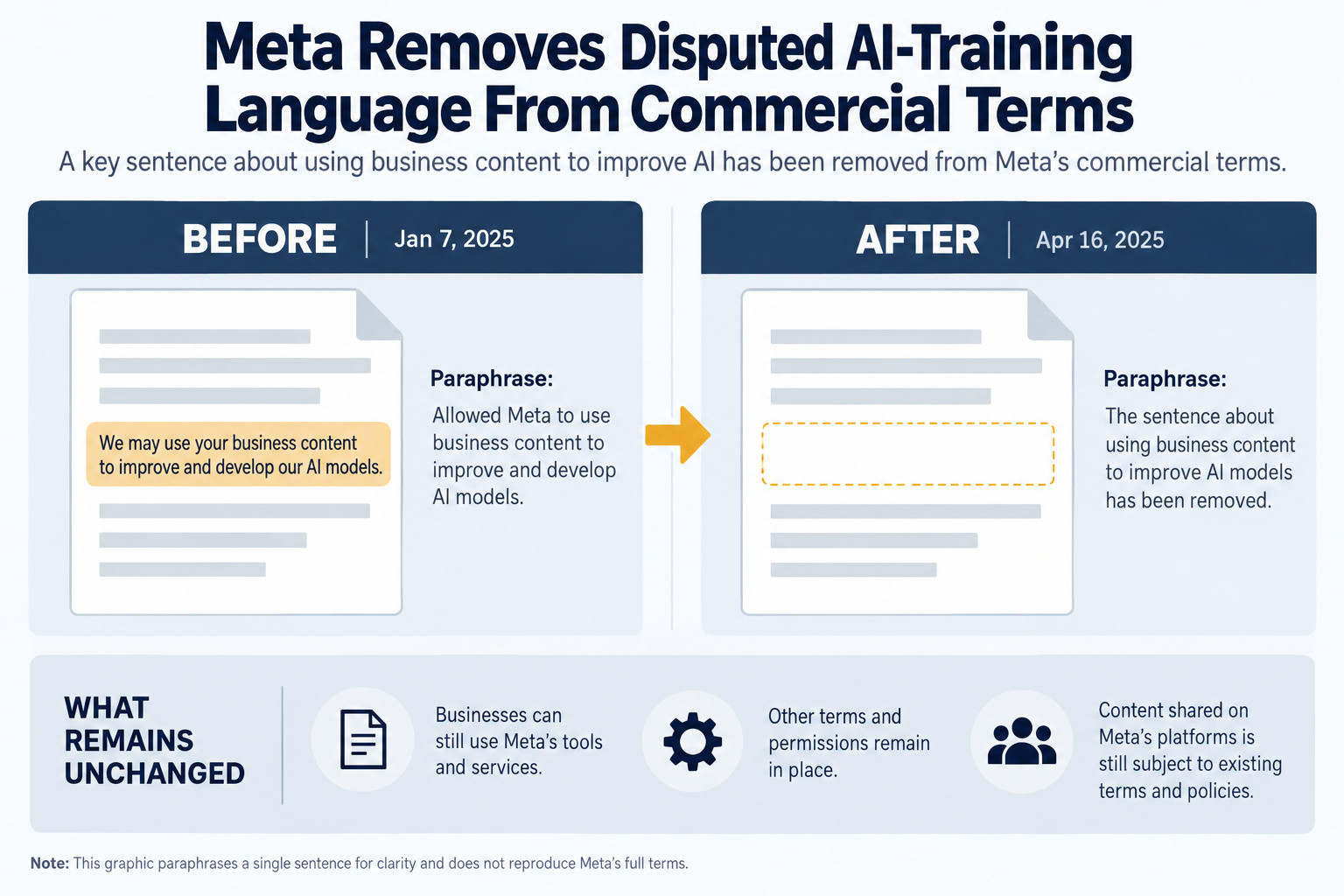
Meta has paused proposed commercial terms changes following objections over permissions to crawl business users’ external websites and potentially use their content for AI training. The updates will not take effect on November 20, 2026, and existing terms remain in force while consultations continue, according to a company statement reported by Reuters. (Reuters, via Investing.com)
The pause covers four sets of rules: Meta Commercial Terms, Product Catalog Terms, Self-Serve Ad Terms and Ad Creative Generative AI Terms. No replacement implementation date was announced in the statement. For publishers and business-page operators, the immediate change is a halt to the proposed updates—not confirmation that Meta has abandoned them permanently. (Reuters, via Investing.com)
“We’re pausing the changes as we continue to engage with stakeholders and take our time to get this right,” a Meta spokesperson told Reuters. The company separately said its existing terms would continue to apply. That distinction limits what businesses can conclude about the announcement’s effect on their content rights. (Reuters, via Investing.com)
Which users and content were involved?
The reporting describes the affected population as Meta Business account users and Facebook business-page operators. The disputed permissions extended beyond material uploaded directly to Facebook to content on external websites linked to those businesses. Ars Technica reported that businesses would have had to permit crawling of linked sites to retain a business Facebook page. (Ars Technica)
That is the central distinction for publishers: the controversy concerned potential access to their own websites, not simply reuse of posts they had chosen to publish on a social platform. However, the precise contractual definition of covered accounts and websites still requires verification against the proposed documents; the reporting alone does not resolve every account configuration. (Ars Technica)
The earlier proposal expressly included training among the purposes for which Meta could use content from covered domains, pages or URLs, according to 404 Media’s account. Other listed purposes included developing, improving and researching its products. That combination prompted concern about how broadly off-platform content could be used. (404 Media)
Meta subsequently removed the reference to training and narrowed the product scope to advertising and business products, 404 Media reported, citing Nieman Lab. But legal experts consulted by Nieman Lab warned that the revised wording still granted broad scraping permissions. Removing one term did not, in their assessment, settle the implications of the remaining language. (404 Media)
A pause after revisions and an earlier delay
The updates were originally scheduled for October 30, 2026, before the planned effective date moved to November 20. By November 5, 404 Media had reported that the changes were paused and reproduced a company notice saying stakeholder consultations would continue. Those dates describe proposed implementation, not evidence that the disputed changes took effect. (404 Media)
The objections were not confined to a single publication’s interpretation. The Associated Press separately reported opposition from media companies and open-web advocates concerned that the permissions could enable Meta to collect website content and develop competing services. Its reporting corroborates the broader dispute, although it does not substitute for a comparison of the contracts themselves. (The Associated Press)
What remains in force—and what remains unclear
Meta’s notice says existing terms remain effective. It does not enumerate the permissions those terms retain or provide a clause-by-clause explanation of how they differ from the paused proposal. Accordingly, the announcement does not establish either that Meta currently lacks permission to use external content or that the disputed proposal merely restated existing rights. (Nieman Lab)
Nor does the notice announce a company-wide prohibition on AI training, a commitment never to revisit the proposal, or a new permanent right to refuse website-content use. Its stated scope is the suspension of these updates during consultation. Treating it as a broader retreat from AI training would go beyond what the company announced. (Reuters, via Investing.com)
A wider debate over publisher choice
Separate developments show why meaningful choice over AI uses matters beyond Meta. On June 3, 2026, the UK Competition and Markets Authority imposed a requirement on Google’s search business intended to give publishers controls over whether their content powers AI search features. The regulator also required an option to exclude content from AI-model fine-tuning. (UK Competition and Markets Authority)
The Google measure is distinct from Meta’s proposed contracts and does not determine their meaning. But the comparison highlights the substantive question behind the dispute: whether publishers can make separate choices about AI uses of their material. The CMA explicitly framed its intervention as strengthening publishers’ bargaining position over content deals. (UK Competition and Markets Authority)
For Meta’s business users, that substantive question remains open. The confirmed outcome is narrower: the November 20 updates are paused, existing terms continue, and the company says it will provide another update when it has more to share. A definitive account of retained permissions still requires the underlying current and proposed terms, rather than an inference from the postponement. (Nieman Lab)