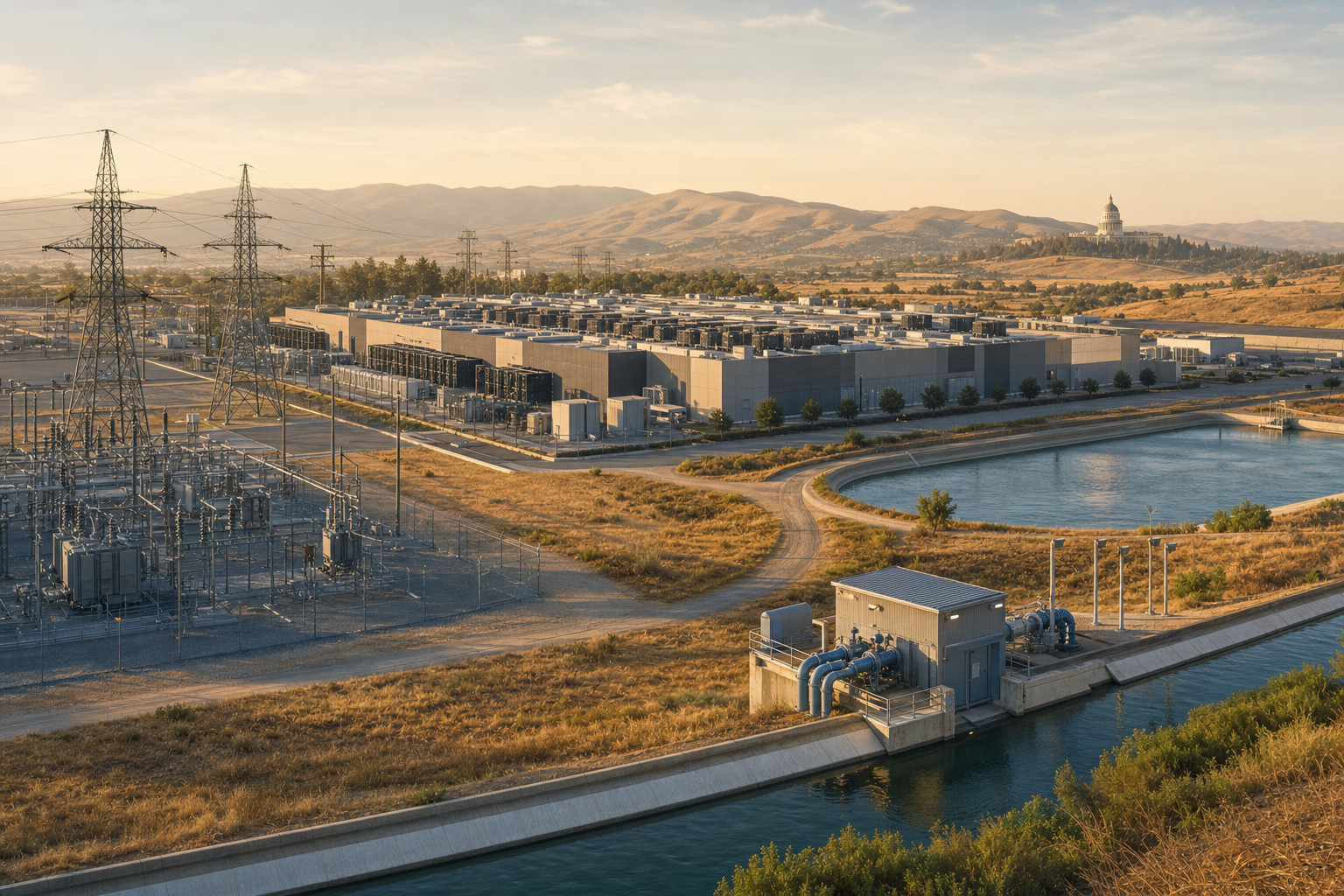
Amazon has confirmed that it acquired the GW Ranch site in Pecos County, Texas, and plans to develop a data-center campus supplied by new on-site electricity generation developed by Pacifico Energy. Project reporting based on air-permit materials describes a proposed natural-gas facility with 35 generating units and up to 7.65 gigawatts of capacity — a scale that would make it an unusually large dedicated power project for a single computing campus.
The project is expected to begin as an off-grid arrangement rather than draw electricity from the Texas power system, according to reporting on Amazon’s plans. Amazon has said the campus is designed to move to grid-connected service as interconnection timelines permit. That distinction matters: Pacifico Energy is identified as the generation developer, while Amazon is the site owner and intended electricity buyer. The available reporting does not establish that Amazon will construct or own the gas plant itself.
The power challenge behind AI computing
The proposal offers a sharp illustration of the infrastructure problem behind the AI-computing buildout. Large data centers need vast amounts of power, and developers increasingly face long waits for transmission, substations and generation capable of serving new loads. For a hyperscale operator, building or contracting for power at the site can offer a path to bringing computing capacity online before a conventional grid connection is available.
Cleanview’s reporting on the project says the Texas air permit issued in January allows up to 33 million tons of carbon dioxide emissions per year. That figure is a permitted maximum, not a projection that the plant will emit that amount annually. Actual emissions would depend on how much equipment is built, when it enters service, how often it runs, its operating profile and other project details that are not yet public in the supplied materials.
The difference is central to assessing the project. A permit ceiling describes the upper bounds regulators have authorized under an application; it does not show the future electricity output of the plant or its realized carbon footprint. Treating the 33-million-ton figure as an annual forecast would overstate what is known. At the same time, the size of the authorized ceiling indicates that the proposed gas component carries potentially significant emissions consequences if it is constructed and operated at high utilization.
On-site generation, solar and storage
Amazon has said the planned campus will rely on new on-site generation and will not raise electricity costs for Texas families. It has also said it is exploring solar power, battery storage, custom cooling and non-potable water sources. Pacifico Energy has said it plans up to 750 megawatts of solar generation and 1.8 gigawatts of battery storage at GW Ranch. Those resources could be material to how the campus is ultimately supplied, but they do not change the reported maximum capacity of the proposed gas plant.
What remains unresolved is as important as what has been disclosed. The supplied reporting does not provide an independently reviewed ERCOT interconnection record, a construction schedule, a complete commercial agreement between Amazon and Pacifico Energy, or a final operating plan for the generation facility. It therefore remains unclear when, or at what scale, the project might be built and how long it could operate separately from the grid. Amazon’s stated intention to transition to grid service is a plan, not confirmation of an approved or completed interconnection.
A broader shift toward behind-the-meter power
The broader direction is not unique to West Texas. In April, the International Energy Agency said data-center electricity use rose 17% in 2025 and that developers, constrained by slow grid connections, were advancing numerous on-site natural-gas projects, particularly in the United States. S&P Global has likewise described grid delays as pushing data-center developers toward behind-the-meter gas generation — power produced for a customer on or near its site rather than supplied through the broader retail grid.
That trend presents a trade-off. Dedicated generation can reduce dependence on an already constrained interconnection queue and may allow computing infrastructure to be deployed faster. But it can also move a major share of energy planning from the grid to private campuses, raising questions about air emissions, fuel supply, local impacts and whether temporary self-generation becomes a durable substitute for transmission and cleaner firm power.
Why Texas is central to the debate
Federal energy outlooks underscore why Texas is central to that debate. The U.S. Energy Information Administration’s 2026 outlook identifies data-center server demand as a major contributor to future electricity growth and says that demand is projected to grow especially quickly in the West South Central region, which includes Texas. The agency also notes that data-center server load is relatively constant throughout the day, a difficult profile for a power system because it requires dependable energy and capacity rather than only occasional peak supply.
For Amazon, the GW Ranch project arrives as the company seeks more data-center capacity amid demand for cloud computing. It does not, on the currently available evidence, prove that every megawatt of the proposed plant will be dedicated to generative-AI workloads or that the facility will reach its permitted maximum. It does show how the rapid expansion of AI-capable computing is becoming inseparable from the practical question of where large volumes of electricity can be obtained — and how quickly.
The West Texas campus is therefore more than a local construction proposal. It is a test case for an emerging model in which a technology company’s growth plans are paired with purpose-built generation while grid access catches up. Whether that model proves transitional or enduring will depend on execution at GW Ranch, the pace of Texas interconnection work, and the availability of lower-carbon power capable of meeting round-the-clock data-center demand.